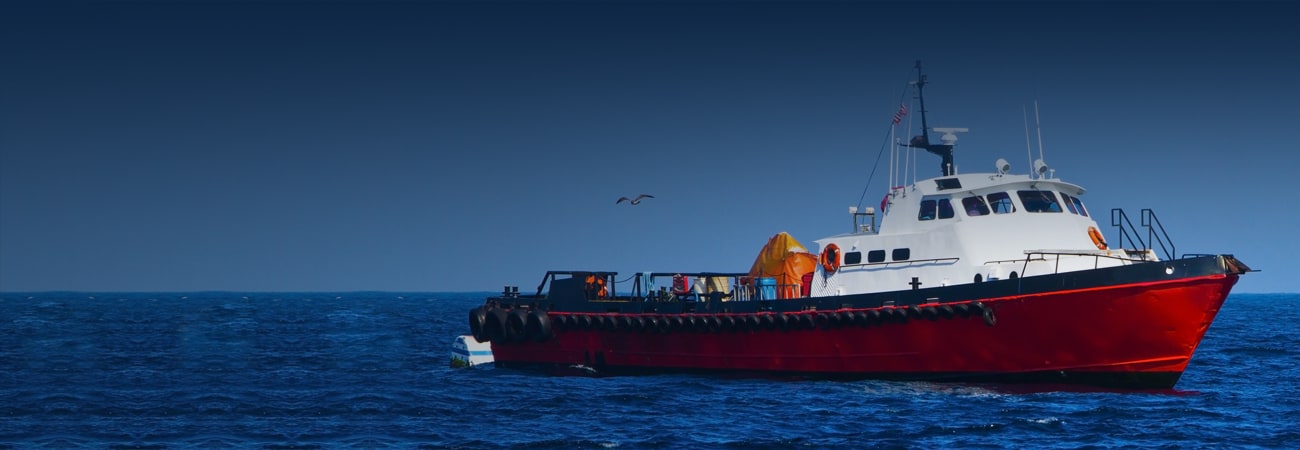
Boat on the sea
Published on:

January 9, around 4:00 p.m., the captain of MISS AUBREY ANN, a 100-foot offshore supply vessel hailing out of Broussard, LA, contacted the Coast Guard for help. One of their crew had apparently had caught his foot in a line, resulting in his foot being severed. MISS AUBREY ANN was about five miles off Louisiana at that time.

The Coast Guard responded with a helicopter medevac, and transported the injured man to Lake Charles Memorial Hospital. The 27-year-old man’s name or current condition have not been released, but at the time, he was reported as stable.

Published on:

At around 1:30 a.m. on December 28, F/V JUNO, a 131-foot, Westport-based fish processor, caught fire while moored at her pier. The JUNO master was on board at the time, but got off safely. No other crew were reported on board.

It took until just after 4:00 a.m. for the Coast Guard and Westport Fire Department to douse the fire, at which time they estimated about 5,000 gallons of firefighting water remained aboard JUNO, causing her to list. The next steps were to remove this water and identify and contain possible pollution sources. So far, no pollution has been reported.

Of course, an investigation of what caused the fire is underway.

Published on:

Back on Saturday, November 9, 166-foot F/V ALASKA MIST experienced mechanical problems and became adrift about thirty miles of Amak Island, Alaska. Amak Island is located in the Bering Sea, north of the midway part of the Aleutian Chain. At first, the ALASKA MIST 22-member crew used a sea drogue and got a tow line from their sister ship, F/V PAVLOV, to slow their drift. Tugboat RESOLVE PIONEER arrived to help, but then they experienced mechanical problems of their own and had to head to port for repairs. Eventually, ALASKA MIST drifted close enough to shore to secure anchor and await rescue in relative safety. Seas during this time period were five to ten feet with winds of 35mph.

All along, ALASKA MIST crewmembers had kept the Coast Guard apprised of their situation, so the Coast Guard was poised to jump in at this point. Coast Guard Cutter WAESCHE arrived on the scene that Monday, November 11, to begin transferring the non-essential members of the ALASKA MIST. By now, the seas were ten feet with winds of 40 to 46mph.
Continue reading

Published on:

Late Saturday afternoon, the crew of F/V NAT contacted the Coast Guard in North Bend, Oregon, with news that they were about to run aground on the south jetty of Yaquina Bay as they headed back to port after setting crab pots.

The vessel did indeed ground there, and the NAT crew swam to shore where they were treated for potential hypothermia. According to reports, the captain required further medical care for broken ribs. It’s fortunate that all crew members survived with no worse injuries.

No pollution was been reported during the grounding or in subsequent salvage operations. Why NAT, a 37-foot wooden-hulled fishing vessel hailing from Long Beach, Washington, grounded is under investigation.

Published on:

Community Attributes, a Seattle-based research firm, has just released their “Washington State Maritime Cluster Economic Impact Study.” Maritime history in our region, most notably fishing and trade, began when the first people settled here many thousands of years ago, followed by European and American expansion, and since then, we’ve experienced an infusion of cultural influence from around the world, creating a background for success.

While there is no question that our maritime industry is deep-rooted and essential to the economy of Washington State, this past May, the Economic Development Council (EDC) of Seattle and King County issued their “Request for Proposals for a Maritime Industry Economic Impact and Cluster Analysis for the Puget Sound Region and Washington State” in order to collect and provide facts supporting the importance of maritime industry here.

The task of Community Attributes, which was awarded the research work, was to identify and assess the contributions of the maritime industry and its connections with the community, as well as its economic impact and growth potential based on qualified, quantifiable data. The study requirements included:
Continue reading

Published on:

Early on November 30, Clint Owens, 41, suffered a head injury aboard Beaufort, N.C.-based F/V SEA ANGELS when part of the rigging equipment struck him. The crew of SEA ANGELS contacted the Coast Guard around 7:00 a.m., as Mr. Owens’ symptoms included short-term memory loss, severe neck pain, jaw injury, and a laceration.

This happened near Ormond Beach, Florida, which is just north of Daytona Beach. The Coast Guard and EMTs quickly arrived in a response boat, immobilized Mr. Owens, and transported him to shore where a helicopter waited to take him to the hospital. His current condition hasn’t been released.

The Coast Guard praised the SEA ANGELS crew for their use of the VHS marine radio. Using a VHS marine radio is more reliable than using a cell phone in these kinds of situations because they broadcast emergency calls to anyone listening, thus increasing the possible number of responses.

Published on:

On Friday, November 15, the weather was windy with high waves in Elliott Bay, Seattle. According to reports, a 30-foot dive survey vessel from Ballard Marine Construction, with five crewmembers on board, capsized in the waves, throwing all five into the frigid waters.

The Coast Guard received the call at 1:55 p.m. and answered with two boat crews. Seattle Fire and Seattle Police Departments also responded to the emergency.

One of the Ballard Marine crew was picked up from the water by the Seattle Police Department, and the Coast Guard rescued another three. But the fifth man was trapped in the cold water under the capsized boat, and wasn’t located for about an half-hour. Four of the rescued crew were taken for medical treatment for hypothermia, and are said to be in good condition. However, the man who had been trapped under the hull remained unresponsive in spite of CPR and care at Harborview Medical Center, and he died later that day.

Published on:

The 93-foot crab boat ARCTIC HUNTER ran aground shortly after leaving Dutch Harbor on November 1, 2013. The crab boat crashed onto the rocks near Morris Cove early Friday morning and remains partially submerged. Numerous vessels responded to the Mayday message with the SAGA SEA being the first on the scene to help rescue the six man crew. The cause of the accident is under investigation by the Coast Guard. The Captain of the vessel was reportedly given two different sobriety tests, one of which he reportedly failed. Some reports have indicated that the captain has explained he had a beer after the ARCTIC HUNTER went aground and before abandoning ship. Other reports have indicated the captain fell asleep at the wheel. The ARCTIC HUNTER is home ported in Kodiak, Alaska.

Efforts to salvage the ARCTIC HUNTER and contain environmental damages have been spearheaded by Magone Marine. The efforts to remove 12,000 gallons of fuel from the vessel have been hampered by high winds and rough seas. Fortunately, there were no reported crew injuries in this matter.

Published on:

The Federal Appellate Court for the Fifth Circuit has entered an opinion, McBride et al v. Estis Well Services, approving punitive damages for seaman in cases involving claims of unseaworthiness. The decision is one of the first Circuit Court decisions to address punitive damages availability in a Jones Act or unseaworthiness action since the Supreme Court of the United States’ land mark decision in Atlantic Soundings v. Townsend. The Atlantic Soundingsdecision declared punitive damages were available to seamen when their employer willfully and callously withheld maintenance and cure benefits. The McBride decision now confirms that punitive damages are also available under the general maritime law doctrine of seaworthiness.

The McBride case involved a barge with a truck-mounted drilling rig on a Louisiana bayou. As crewmen were attempting to straighten the monkey board – the catwalk that extends from the derrick – which had twisted the previous night, the derrick pipe shifted, causing the rig and truck to topple over. One crewman died in the accident and three others were injured.
Continue reading

Published on:

American Seafoods Group, one of biggest commercial fishing companies involved in the Alaska pollock fishery, has sold their east coast seafood processing business, American Pride Seafoods. The sale to High Liner Foods was announced October 1, 2013. High Liner Foods reportedly paid $34.5 million for this subsidiary of American Seafoods. The American Seafoods sale of American Pride Seafoods marks a departure from the company’s previous sea-to-plate market integration.

American Pride Seafoods is a value-added frozen seafood and scallop processing business with revenues of $190 million reported in 2012. Typical products include breaded seafood products such as fish and chips, frozen seafood, and seafood packaged for use by restaurants and retail food providers. High Liner Foods indicated that they intend to continue to operate American Pride Seafoods at the New Bedford location without any substantial changes at this time.
Continue reading

Contact Information