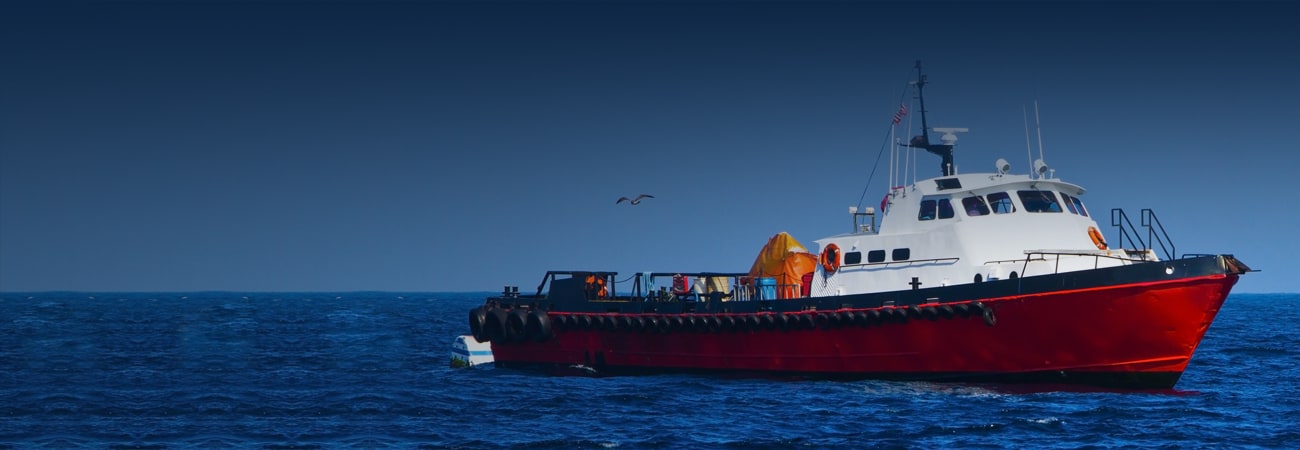
Boat on the sea
Published on:

A 61 year old crewman was evacuated from the 88-foot scallop boat EILEEN MARIE on Saturday. The crewman reportedly had been hit on the head by a scallop dredge and was barely responsive. The accident happened 50 miles off the coast of Cape May. The Eileen Marie is home ported in New Bedford, Massachusetts. The Coast Guard airlifted the crewman for emergency medical treatment at AtlaniCare Regional Hospital in Atlantic City for treatment. The cause of the accident is unknown.

Beard Stacey & Jacobsen is one of the nation’s leading maritime injury firms. A Boston jury returned a two million dollar verdict for their client last year in a case involving a New England scallop boat. Crewmen working on scallop boats are at high risk for injuries, given the nature of the dredging operation and deck work.

Published on:

Tuesday, the 58-foot seiner POLAR STAR ran aground and began taking on water 65 miles west of Kodiak. The crew of the vessel issued a mayday message indicating the crew of five were abandoning ship into the vessel’s seine skiff. The Coast Guard responded to the emergency via helicopter. The crew planned to return to the vessel at high tide to see if they could refloat the vessel. The cause of the grounding was unknown. Weather conditions at the time of the accident were mild, with 23 knot winds and three-foot seas.

Published on:

The 34 foot fishing boat ROSIE MARIE sank 20 miles west of the Columbia River Bar on Tuesday. The sole crewman on the vessel was able to get off a May Day message and activate his EPIRB before abandoning the sinking vessel into a life raft. The Coast Guard sent a helicopter from Astoria and a life boat from Cape Disappointment to rescue the man who was hoisted to safety by the helicopter. The crewman was taken to Astoria Oregon for medical examination. The cause of the accident is under investigation. Safety regulations relating to small fishing boats such as this are currently pending, including requirements for life rafts, EPIRB, and immersion suits. This instance again points to the fact that this safety equipment saves the lives of fishermen and the need to make such safety equipment mandatory on all fishing vessels.

Published on:

Four crewmen have been rescued after their Alaska fishing boat caught fire on Sunday. The 52-foot longliner NAKAT from Kodiak caught fire about 80 miles southwest of Kodiak. The crew was unable to issue a mayday message before abandoning ship into the vessel’s life raft. The Coast Guard was alerted to the accident after receiving an EPIRB message from the vessel and immediately dispatched a rescue helicopter. The crew was located several miles away from the burning vessel and hoisted to safety. The cause of the fire is under investigation. This case again demonstrates the importance of the EPIRB and the role it plays in saving fishermen’s lives in Alaska.

Published on:

Highland Light Seafoods, a Seattle Seafood Processor headquartered in Seattle, has agreed to pay a $135,00 penalty for violations of the Clean Water Act. The violations stem from an inspection of the 160 foot WESTWARD WIND in December of 2008 and involve multiple alleged violations over a five year period. The EPA charged that the WESTWARD WIND was not in compliance with its National Pollutant Discharge Elimination System permit (NPDES). Allegations included improper discharges of waste product, failure to maintain records, excessive discharges of waste. A Spokesman for the EPA stated that “monitoring is the cornerstone of the NPDES Program and provides real time input for the company on the effectiveness of its operation. Using monitoring to improve operations is an important step in reducing the effects of discharge on the environment.

Published on:

A Boston whale watch boat ran aground on a rocky ledge and began taking on water, forcing evacuation of 174 passengers and crewmen. The accident happened on July 3rd near Deer Island in Boston Harbor. The 87-foot long tour boat MASSACHUSETTS was reportedly traveling at 18 knots when it struck rocks at a place called Devil’s Back Ledge. The tour boat began to take on water and list with its bow down. Numerous vessels in the area assisted the Coast Guard in rescuing the passengers who were taken three miles to a pier in Hull. Remarkably, no serious injuries were noted at the time of the accident although the unexpected collision threw many passengers to the deck. The MASSACHUSETTS is owned by Massachusetts Bay Lines of Boston, which owns and operates harbor cruises and tours.
The accident is under investigation by the Coast Guard. Devil’s ledge/rock is a well known navigational hazard in Boston Harbor and it appears that navigational error will be the focus of the investigation. Even in well known and charted waters, vessel owners and tour operators must be fully ready to respond in case of a disaster.

Published on:

The tow boat BEAR CAT has been involved in a collision with a small pleasure craft on the Tennessee River. Only one of three persons aboard the small craft survived the accident. Early reports about the June 19, 2010 accident indicate that neither the tow boat nor the small boat was aware of the impending collision. The cause of the accident and why lookouts aboard the tug failed to sound a warning is under investigation by the Coast Guard. The BEAR CAT is owned by Serodino Inc. of Chattanooga.

Published on:

A Seattle woman has been killed aboard a construction barge in Seattle. The woman’s relationship to the construction barge working in Seattle’s Elliott Bay is unknown. The death was reportedly the result of the woman being hit in the head by a crane on the barge. The barge was moored just south of Seattle’s downtown waterfront.

Workers aboard marine construction barges may be classified as Jones Act seamen. The legal status of an accident victim is critical to determine what compensation may available in the case of a wrongful death.

Published on:

Wesley Keller, a member of the Alaska State House of Representatives, and Vice Chair of the Alaska House Fisheries Special Committee, was cited June 11, 2010, for an illegal sport fishing violation. Keller was fishing with two poles near the entrance to Halibut Cove in Kachemak Bay. He was issued a $110 citation for the violation. Keller, who is a republican from Wasilla, was elected to the Alaska House of Representatives in 2008.

Published on:

The Federal Fifth Circuit Court of Appeals has recently held that an undocumented immigrant who is injured at work is not excluded from receiving benefits under the Longshore Harbor Workers Act. In Bollinger Shipyards v. U.S. Department of Labor et al., 2010 WL 1614594 (2010) an alien without proper working papers submitted a false Social Security number to obtain employment in a shipyard as a pipe fitter. Arguing that the undocumented worker was precluded from compensation benefits because he was ineligible to work in the United States, the employer argued that the injured worker was similar to a “car thief,” a “pirate,” or a “drug dealer” who was making money through “ill gotten gains.” The Fifth Circuit rejected the employer’s argument, affirming its prior decision in Hernandez v. M/V RAJAAN, and again declared that undocumented immigrants are eligible to recover workers’ compensation benefits under the Longshore Harbor Workers Act.

Contact Information